Organizing Cross-Shot Continuity in Generative AI Short Films: A Case Study of As Usual
LIU MENGZHU, Undergraduate Student, Dept. of Film and Visual Effects, DONGSEO UNIVERSITY
BUSAN, Korea (south)
DENG XINRUI, Undergraduate Student, Dept. of Film and Visual Effects, DONGSEO UNIVERSITY
BUSAN, Korea (south)
XIE YITONG, Undergraduate Student, Dept. of Film and Visual Effects, DONGSEO UNIVERSITY
BUSAN, Korea (south)
BOWEN, Undergraduate Student, Dept. of Animation, DONGSEO UNIVERSITY
BUSAN, Korea (south)
SHARA NUWENG, Undergraduate Student, Dept. of Computer Science, DONGSEO UNIVERSITY
BUSAN, Korea (south)
ZHOU JIANI*, Assistant Professor, Dept. of Film and Visual Effects, DONGSEO UNIVERSITY
BUSAN, Korea (south), moses472530@gmail.com
* Corresponding author
Abstract — Generative AI is now used in short-film script development, visual generation, and sound production, yet shots generated separately often exhibit discontinuities in character appearance, spatial orientation, and audiovisual texture. This paper examines how a multi-model workflow supports continuous storytelling through As Usual, a 6- minute-57-second family drama. Centered on the return of an “AI grandmother” to everyday family life, the film explores the difference between technological replication and genuine care. The production followed a workflow of establishing master shots, locking reference assets, generating individual shots, making targeted corrections, and integrating sound and image. Character drift, spatial mismatches, content-generation restrictions, and inconsistencies in sound and color were addressed at different stages. The case suggests that cross-shot continuity depends on defining spatial and character constraints before generation and shaping emotional rhythm through editing and sound design. It proposes a layered control approach for small-scale narrative films, in which shot relationships and character emotions take precedence over generation efficiency.
Keywords — Generative Ai, Ai Short Film, Cross-Shot Continuity
I. Introduction
Video generation models have improved their depiction of brief actions and fine visual detail, but multi-shot works still struggle to preserve character features and spatiotemporal information. Prior studies have examined temporal consistency in video and character identity across shots [1–3]. Such work primarily addresses the preservation of visual features. In filmmaking, however, continuity also depends on who is looking at whom, where people and objects are positioned, and how an action carries from one shot into the next. A convincing single frame does not necessarily make a coherent scene.
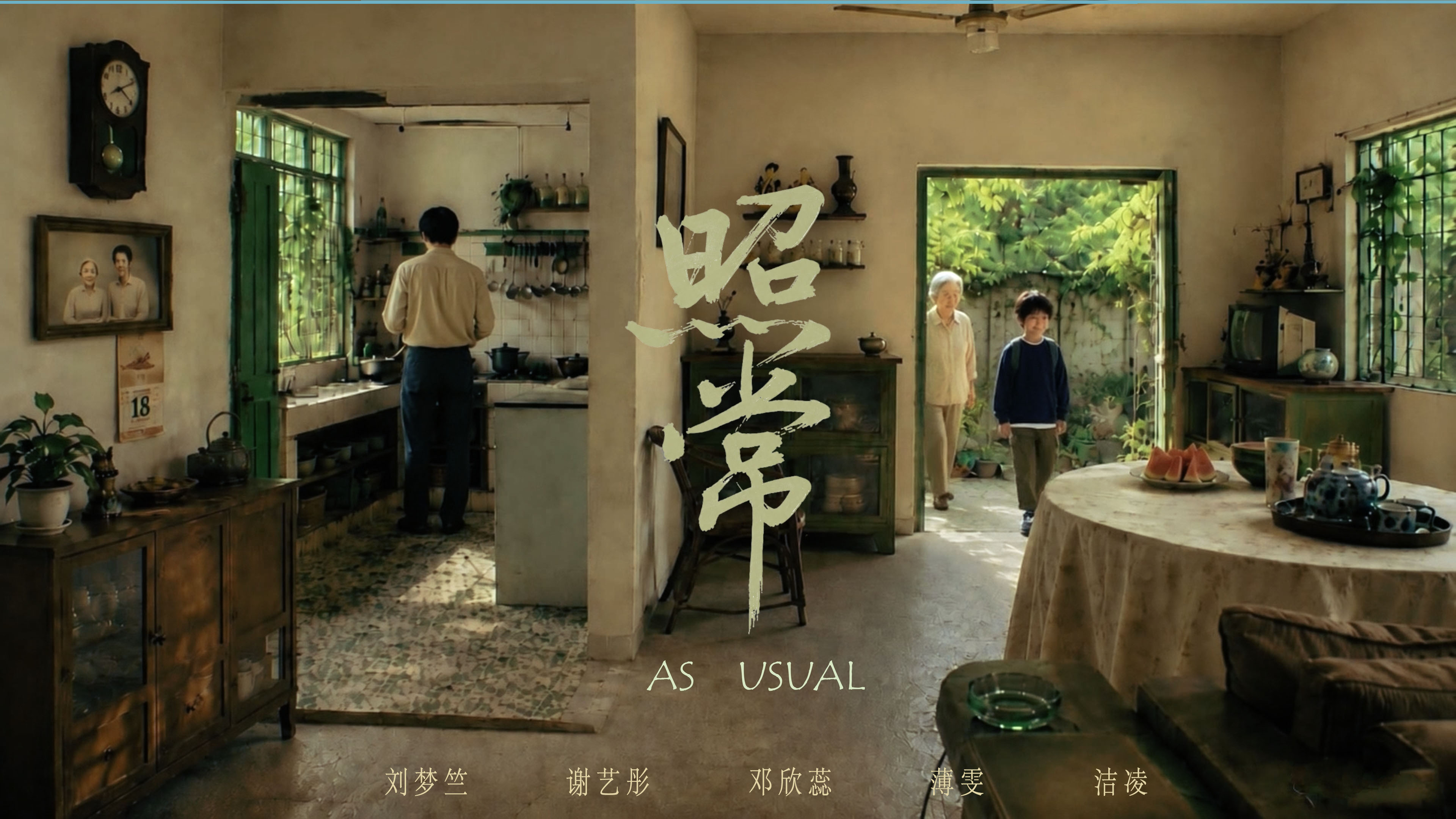
As Usual is set in the near future. After the grandmother dies, a father purchases a family companion service that reproduces her appearance, voice, and habits, hoping to restore a familiar everyday life for his son. When the child is injured, however, he comes to recognize that outward replication cannot replace care informed by situational judgment. He must then decide whether to renew the service. Rather than presenting technology as a spectacle, the film situates it at the dining table, in the kitchen, and in the courtyard. The more intimate relationships are built through small details, the more readily minor discontinuities between shots can disrupt the emotion of a scene. The domestic geography is established in the opening family space (see Figure 1).
The long-term goal of this research is to explore how generated imagery can support narratives with sustained space, time, and character relationships. The present study focuses on shot transitions in the production of As Usual and examines the roles of spatial reference, character assets, and audiovisual organization in post-production. Its central question extends beyond whether spatial relationships are correct: how can visual, performance, and auditory information maintain intelligible causal relationships across independently generated shots?
Figure 1. A domestic setting and family relationships in As Usual (film still and title image).
II. Material and Methods
The film uses Mandarin dialogue and a 1.85:1 aspect ratio, with a realistic visual approach and restrained shifts between warm and cool tones. Production proceeded through script and shot-list development, still-image design, video generation, sound production, and post-production integration. ChatGPT assisted with script development and written storyboards; ChatGPT and Midjourney were used for still images; Higgsfield, Kling, LibTV, and Seedance supported video generation. Music and character voices involved Suno and Minimax, respectively, while DaVinci Resolve, Vmake, and Topaz were used in post-production. Tools were assigned different tasks according to the degree of shot control and the sound requirements.
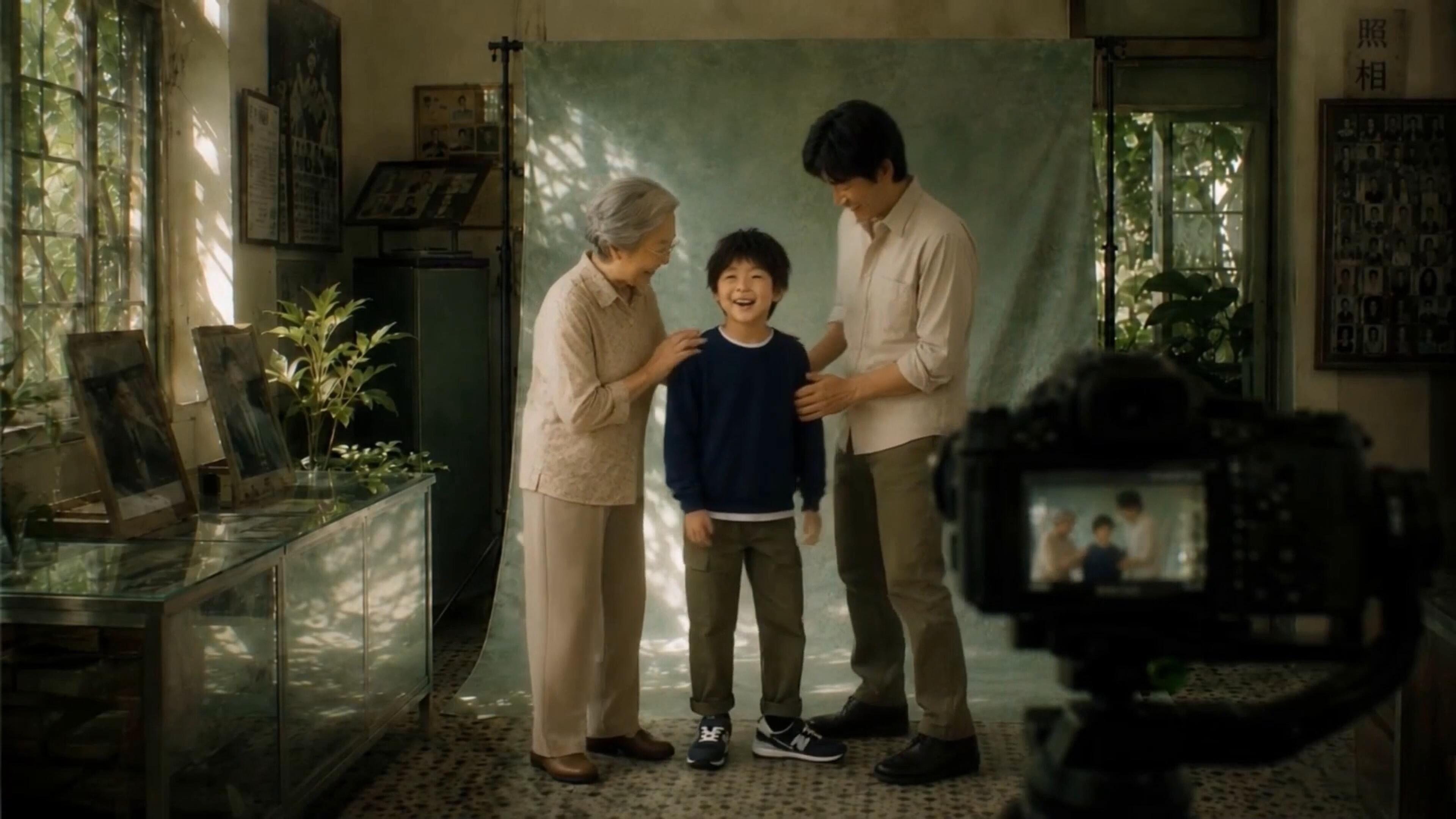
Visual production began with a master wide shot to establish room layout, character positions, and prop placement. Actions, expressions, and individual objects were then separated into tasks and developed as editable shots. Approved stills served as references for subsequent character and location generation. Local errors were addressed through masking, targeted replacement, and single-object edits rather than repeated full-frame regeneration. The master shot provided a reference for checking eyelines and camera-axis relationships; reusable asset references were developed for distorted props. This approach shifted the editing objective from generating another attractive image to correcting a specific variable that affected shot continuity. A posed family portrait provides an example of recognizable character relationships (see Figure 2).
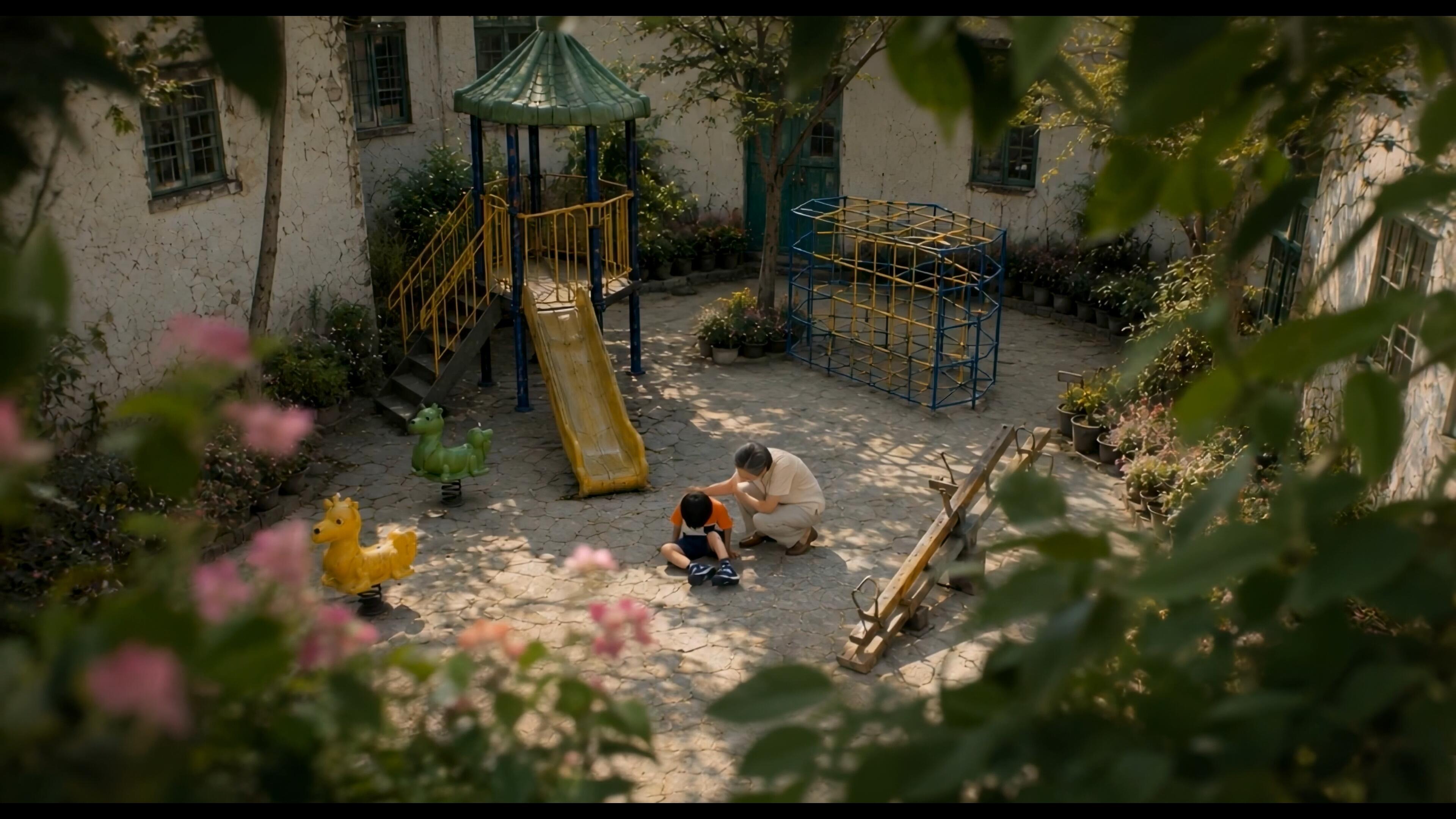
The scene involving a child’s injury posed both narrative and platform-content challenges. Instead of emphasizing a visible wound, the production conveyed the event through the child’s already-bandaged condition, family caregiving actions, and character reactions. This avoided sensitive descriptions that could cause generation failures while retaining the father’s reassessment of the AI grandmother as the dramatic focus. After voice generation, differences in vocal timbre and loudness were addressed through equalization, compression, and volume automation. Ambience and sound bridges were used where necessary to connect shots. During editing, node-based grading and shot matching addressed color temperature, exposure, and skin tones; facial artifacts were repaired locally, and cutaway details helped ease abrupt transitions. The incident is first located within the courtyard (see Figure 3).
Figure 2. The grandmother, child, and father assembled in a family portrait scene.Figure 3. Establishing view of the courtyard where the child-injury sequence takes place.
III. Results
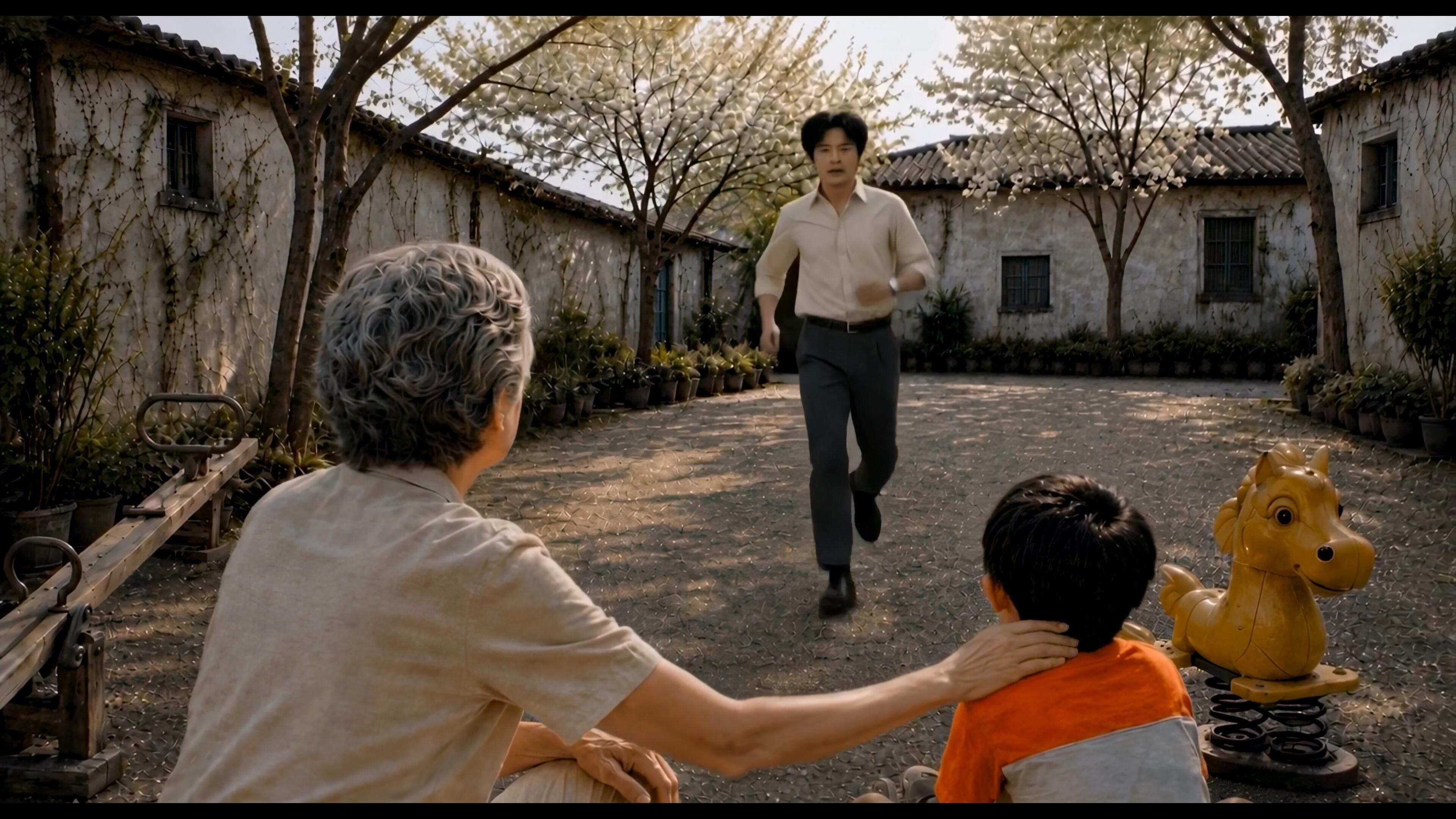
The project resulted in a 6-minute-57-second AI family drama. Beyond producing images, its practical outcome was an editable narrative assembled from independently generated material. Spatial orientation in domestic scenes was supported by master-shot references; local deformations in characters and props were corrected through reference locking and targeted repairs; and sound, color temperature, and emotional pacing were unified in post-production. The placement of the father, child, and grandmother makes their actions legible (see Figure 4).
In terms of dissemination, As Usual received first prize in an AI short-film competition associated with Dongseo University in South Korea and was officially selected for the World AI Movie Festival (WAIMF, 2026) and Almamoura Festival (2026). These distinctions indicate a degree of external recognition but do not substitute for a controlled evaluation of the continuity workflow.
Figure 4. Spatial and eyeline relationships among the father, grandmother, and child in the courtyard.
Table 1. Production problems, responses, and qualitative outcomes in As Usual
Problem
Production response
Observed qualitative outcome
Character and prop drift
Locked references; masking and targeted replacement
Reduced unintended full-frame; changes and preserved features across; adjacent shots
Spatial and eyeline mismatch
Established a master wide shot before checking camera positions and character orientation
Provided a shared spatial reference for dialogue and action
Restrictions on depicting a child's injury
Showed bandaging and caregiving rather than the injury itself
Preserved narrative causality while shifting attention to character judgment
Differences in voice, exposure,and shot transitions
EQ, compression, volume automation, shot matching, and sound bridges
improved scene connections and emotional continuity
IV. Discussion and Conclusion
Research on generative video increasingly addresses temporal coherence and identity consistency across shots. The difficulties encountered in As Usual suggest that cinematic continuity cannot be assessed solely by whether a character looks the same. Eyelines, spatial orientation, action causality, perceived sound distance, and emotional progression must work together. A useful contribution of this project is its adaptation of the conventional staging principle—establish space before constructing details—into an operational sequence for a multi-model workflow. Each shot is assigned a clear spatial position before a generation or correction strategy is chosen. This is a production-level method of control, not an improvement to model algorithms.
A distinctive feature of the film is the correspondence between its technical challenges and narrative theme. On screen, the AI grandmother can reproduce a voice and familiar habits, but simulation alone does not constitute a caring relationship. Behind the screen, AI tools can generate convincing individual images but cannot automatically sustain the emotional coherence of an entire scene. The child’s injury is not treated as a sensational visual event; the family’s response becomes the turning point. Here, platform restrictions helped shape a narrative choice: companionship is judged by how one responds to another person rather than by what one can replicate. Technical constraints do not automatically create aesthetic value. They become deliberate storytelling devices only when the alternative still communicates the causal logic of the story. An ordinary domestic object becomes a restrained visual trace of disruption (see Figure 5).
The case also reveals the limits of the current approach. First, chaining multiple tools still requires manual checks of characters, props, and screen direction. Second, differences in sound and color shift corrective work into post-production and may increase the cost of revisions. Third, the study does not include per-shot generation counts, production-time records, or audience testing, so it cannot statistically isolate the contribution of individual measures. Future work could compare free-form generation against a workflow constrained by master shots and reference assets within the same scene, recording revision rounds, spatial errors, and editing time, alongside audience assessments of character relationships and emotional comprehension.
In summary, As Usual demonstrates a practical way to organize generative production around family storytelling: establish relationships before generation, constrain variables during generation, and complete narrative continuity through editing and sound. As model capabilities advance, the creator’s task may increasingly shift from obtaining usable images to deciding which relationships must remain stable and which details are worth preserving.
Figure 5. Broken tableware and watermelon as a narrative detail conveying the aftermath of an incident.
References
[1] Yin Z, Chen K, Bai X, et al. A Survey: Spatiotemporal Consistency in Video Generation[EB/OL].