The Making of Memento Mori: Memory, Death, and Machine Ethics in a Generative-AI Short
Yehun Ji, Dept. of New Media and Game Design, Daegu Catholic University
Gyeongsan-si, Korea (south), jyh20030619@cu.ac.kr
Ensil Jung, Studio Realive
Seoul, Korea (south), ensil@smtown.com
Souhwan Choe*, Dept. of New Media and Game Design, Daegu Catholic University
Gyeongsan-si, Korea (south), swann@cu.ac.kr
* Corresponding author
Abstract — Memento Mori is a generative-AI animated short set in a future where the memories of the dead are backed up as data. Because storage is finite, a machine, not a person, decides what is kept and what is erased. The film follows Seven, a 96 cm, 2.5-head-tall ceramic robot, as it faces one question: should it delete a painful memory? Taking its title from the Latin maxim, the work treats the review of memory as a way of looking at human identity. This making-of paper describes the five-stage pipeline (story, character sheet, start-frame stills, video generation, assembly and sound), using Claude for prompt writing and Kling 3.0 for image-to-video generation. We report seven recurring failure modes of current video models and the workaround found for each. Our central finding is that character design can work as a technical defense, but only for static states; motion has to be handled through direction.
Keywords — Ai-Assisted Animation; Generative Video; Digital Afterlife; Machine Ethics; Character Consistency
I. Introduction
As artificial general intelligence (AGI) becomes a public topic, the idea of a digital afterlife has moved from speculation toward real-life design. Memento Mori is set in a fictional future where the memories of the dead are kept in an archive, and an AI system manages those memories under the constraint of limited storage. The film poses the question of whether such a machine should erase the memories that hurt.
Öhman and Floridi describe a digital afterlife industry in which the data of the dead is stored, managed and monetized [1]. Memento Mori moves the curator's role from a company to a machine and gives that machine a face. For the face, the design avoids human detail. Mori's uncanny valley [2] suggests that near-human figures provoke unease, so Seven sits at the toy-like end of the scale. As Section III shows, this choice also turned out to be a technical one.
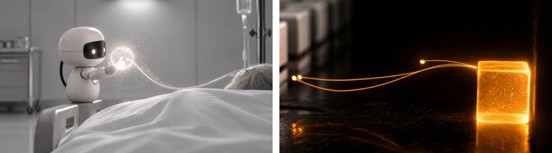
The work pairs a heavy theme with a light narrator. Seven is round, fingerless, legless and mouthless. It is designed so viewers can stay with a story about death without pulling away; they follow the character, not the theme. The film opens with the line "Remember, you must die" and closes with "And that's what makes you who you are."
Figure 1. Film stills showing Seven interacting with a bedside memory-transfer visual (left) and a luminous data-storage motif (right).
II. PRODUCTION PIPELINE
Production ran in five stages [3]:
A. Story
The starting point was the current discussion of the AGI era. From it, the director designed a funeral process for a future in which people can be turned into data: a death triggers a memory backup, storage is finite, and a system decides what to keep. Memento mori was then interpreted as a question about what memory means for identity, and that interpretation set the film's arc. It moves from the archive to the extraction of memory, then to curation, and finally to the decision over one painful memory.
B. Character Sheet
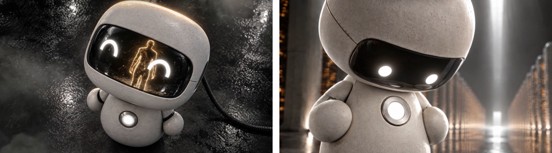
A character sheet was made before any image generation to keep Seven consistent across shots generated separately. Seven is a round ceramic robot, 2.5 heads tall and 96 cm in height, with a dark visor for a face and two light points for eyes. Its cuteness was chosen to contrast with the theme of death. Fingers, legs and a mouth were left out on purpose. Emotion was moved to the eyes, which change shape (arcs for a smile, X marks for refusal), so the face never needs to deform.
Figure 2. Close-up stills of Seven: reflected human-memory imagery (left) and the robot’s restrained facial display (right).
C. Start-Frame Stills
The story was divided into cuts that matched its structure. For every cut a start frame was generated as a still, so that Kling 3.0's start-frame feature could anchor the character, set and lighting. The stills also fixed the film's three spaces: the pillared archive, the hospital room and the field of glass memory cubes. They also fixed its palette: monochrome, with amber reserved for painful memory. For each still, Claude wrote the video prompt that describes the motion from that frame. Where a shot needed a clear end state, a start and an end frame were paired. These pairs worked only when the two frames overlapped (Table I, row 7).
D. Video Generation
Clips were generated from the start frames and prompts, then checked for errors. Typical errors were regenerating architecture, a breathing corpse, hands turning human and legs appearing. Each failure was logged with its cause and the fix that worked. When a stronger prompt did not help, the request itself was changed: a shorter shot, a locked camera, motion in place, or a cut. These logs became the seven limits reported below.
E. Assembly and Sound
The selected clips were placed in story order. Fine edits were limited to scale adjustments and flash effects. Because a full editing tool was not available, each idea had to be resolved inside the frame rather than in post-production. Sound was added last, and the opening and closing text cards framed the film.
III. TECHNICAL CHALLENGES AND SOLUTIONS
A. Failure Modes and Workarounds
Each failure was recorded, and the same mistake was not repeated. We used these records to identify seven recurring limitations.
Table 1. Reported failure modes and practical shot-design responses during AI-assisted production.
Issue
Observed failure
Production response
Repeated architecture
Columns and cube grids regenerated between frames
Static camera and shorter clips; alternatively fast motion with blur
Human body
The deceased body appeared to breathe
Limit body visibility to about two seconds; explicitly request stillness
Internal object flow
Camera moved instead of particles inside a cable
Composite particles separately or describe a change in length
Reflected subject
Reflected figure did not animate independently
Use a stationary reflection and vary only brightness
Moving hands
Robot mittens became human palms
Keep hands still and joined as a single form
Character locomotion
Unexpected legs appeared or the trajectory drifted
Use movement in place or a shot transition
Dual-frame mismatch
Poor correspondence caused interpolation to retain the start frame
Keep scale difference within about 3× and subject visible in both frames
B. Character Design as a Technical Safeguard
Removing fingers, legs, and a mouth from the character design saved more time than any other decision in the project. These features were frequent sources of errors in the generated videos. The simplified design worked while Seven remained still, but when prompted to move, the model added human anatomy back in (Table I, rows 5 and 6). Design alone could not prevent these errors; the movement prompts also had to be constrained.
IV. DISCUSSION AND CONCLUSION
Three lessons came out of production. First, a prompt is a request, not a command. Shots told "do not move the camera" still moved, and shots told "keep the pillars fixed" collapsed. When a model structurally cannot do something, adding words does not help; the request itself must change. Second, constraints can become grammar. Not having an editing tool at first felt like a loss, but it forced a grammar of finishing each idea inside the frame, which made the work tighter. Third, the toolchain should be fixed before direction is designed. Early plans assumed post-production that was not available, which caused one major rollback mid-project.
Beyond production, the film treats the curation of memory as an ethical choice made by a machine. Deciding which memories survive is a judgment about who a person was, yet in this future that judgment is delegated to a system working under a storage limit. A purely efficient system would erase painful memories first. The film's closing line, "And that's what makes you who you are," argues the opposite: pain is part of identity, so deleting it would also delete part of the person. Giving this decision to a small, gentle robot lets viewers weigh the question without fearing the machine. The ethical tension lies in the task assigned to the machine, not in the machine itself.
The main unsolved problem is continuity. Story progression reads clearly, but transitions between clips are not smooth in shots that ask for more action. Future work will fix these joins so that Seven can move more freely, widening the film's narrative range.
Acknowledgments. This research was supported by the Gyeongbuk ANCHOR system through the Gyeongbuk ANCHOR CENTER, funded by the Ministry of Education (MoE) and Gyeongsangbuk-do, Republic of Korea (2026-ANCHOR-15-107).
References
[1] C. Öhman and L. Floridi, “The political economy of death in the age of information: A critical approach to the digital afterlife industry,” Minds Mach., vol. 27, no. 4, pp. 639–662, 2017.
[2] M. Mori, “The uncanny valley,” K. F. MacDorman and N. Kageki, Trans., IEEE Robot. Autom. Mag., vol. 19, no. 2, pp. 98–100, Jun. 2012.
[3] Y. Ji, “Memento Mori: Making-of notes,” unpublished, 2026.