Color, Framing, and Motif in the AI-Assisted Short Film “The Taste That Lingers…”
Abstract — This paper analyzes the visual language of The Taste That Lingers… The film follows Hayun, a girl raised in a hospital by an overprotective father, as street food shared by the volunteer Chaeon opens her to the world. With spoken dialogue removed, meaning is carried by color, repeated framing, and three motifs: food, the notebook, and the window. Frame measurement shows mean saturation rising from 0.09 in the hospital routine to 0.32 in the night outings, then falling to 0.12 on her return. We show how we turned the limits of AI video generation into a restrained directing style that suits the film's theme of confinement.
Keywords — Generative Ai, Visual Storytelling, Color Script, Ai-Assisted Filmmaking, Generative Video
I. INTRODUCTION
Generative AI video tools let filmmakers and designers bring their imagination into reality without a stage set or actors and staff. Yet this technology also limits boundaries of expression: different faces between shots and unnatural details in large movements. To address these limitations, a director has to use visual language as much as technology.
The Taste That Lingers… (맛은 기억보다 오래 남는다) is an AI-assisted short film where a mother's dying wish, "protect her, make her happy," turns a father's love into a form of confinement and his daughter Hayun grows up knowing the world only through hospital meals and a diary of flavors she imagined. This film tries to express the main character's emotional transformation using only visual language, without dialogue.
II. Theoretical Background
Block [1] describes visual structure as the controlled contrast and affinity of components such as tone, color, space, and movement; dramatic intensity rises with contrast. Bellantoni [2] shows that color carries consistent emotional associations, with desaturated cool palettes reading as withdrawal and warm saturated hues as vitality. Bordwell, Thompson, and Smith [3] treat a motif as a repeated element whose meaning shifts with context. These ideas frame the analysis: color contrast, repeated composition, and evolving motifs.
III. Production and Method
This AI-assisted film was created through five stages: 1) writing the scenario, 2) designing characters and background images, 3) making per-scene image sheets, 4) AI video generation in Kling AI and 5) editing with sound [4].
To reduce the side effects of AI such as distorted faces and bodies, we created more detailed character sheets and focused on small motions such as gazes, breathing, and hand gestures. In the editing process, we removed spoken words for audiences to imagine the story themselves and we use music and sound to provide deeper immersion.
To write this paper, we analyzed the finished film (1920×1080, 280 seconds in length) along with our production notes and full scenario. We reviewed frames sampled every 3 seconds shot by shot. To verify the color design, then, we measured mean luma, HSV saturation, and red-minus-blue warmth (0–255 scale) across nine narrative segments (Table 1) using frames sampled at 1fps.
IV. Analysis
Table 1. Mean frame metrics by segment (1 fps sample).
| Segment | Time | Luma | Saturation | Warmth |
|---|---|---|---|---|
| Mother's ward (prologue) | 0:03–0:32 | 0.24 | 0.17 | 0 |
| Father alone in kitchen | 0:50–1:04 | 0.15 | 0.24 | +12 |
| Hospital routine: meal, window | 1:09–1:26 | 0.41 | 0.09 | +1 |
| Chaeon in the ward | 1:27–2:15 | 0.41 | 0.16 | +10 |
| Night outings | 2:24–2:51 | 0.29 | 0.32 | +22 |
| Return and conflict | 2:54–3:27 | 0.28 | 0.12 | +7 |
| Father prepares lunchbox | 3:30–3:50 | 0.13 | 0.28 | +14 |
| Lunchbox handover | 3:51–4:00 | 0.40 | 0.19 | +18 |
| Open-window ending | 4:06–4:13 | 0.38 | 0.18 | +11 |
A. Color as emotional script
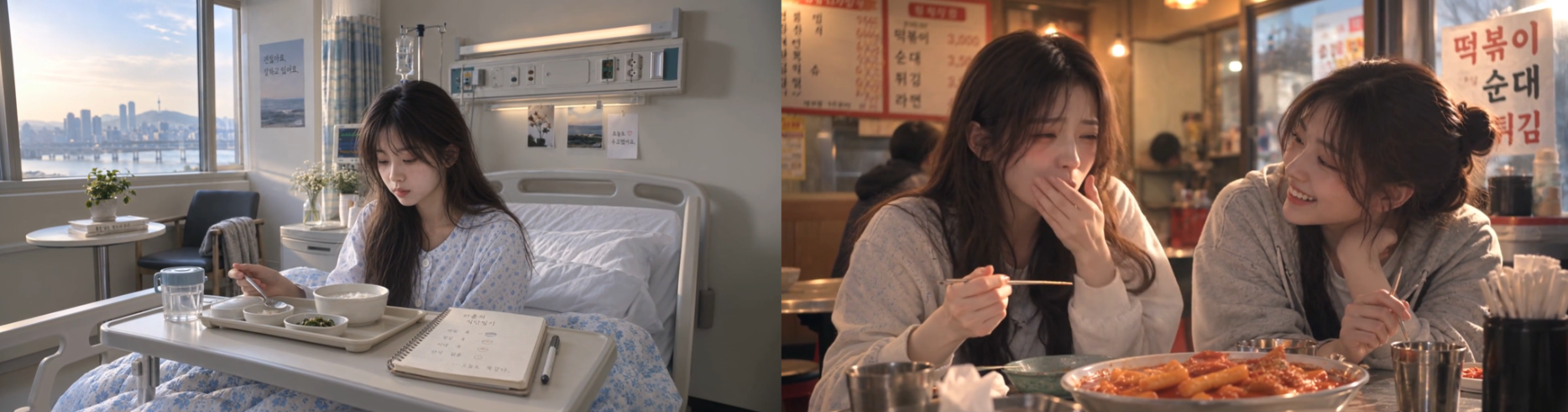
The hospital routine is the brightest and least saturated passage. White bedding, pale blue florals, and grey daylight make safety look flavorless. The outings to a fish-cake stall, a tteokbokki shop, and a riverside bench at dusk more than triple saturation, as orange tungsten light and red sauce fill the frame. On Hayun's return saturation drops to 0.12; in Block's terms [1], a return to affinity after strong contrast reads as loss. Warmth then rises in the father's kitchen and the lunchbox scene, so the warm palette first tied to Chaeon passes to the father. Color tracks who brings the world to Hayun.
B. Framing and camera
We relied on static or slowly pushing shots, close-ups of hands, and medium shots in which characters rarely move beyond a head turn. We chose this approach because large motion in AI video distorts faces and limbs [4]. The restraint doubles as meaning: Hayun is held in still frames as she is held in the ward.
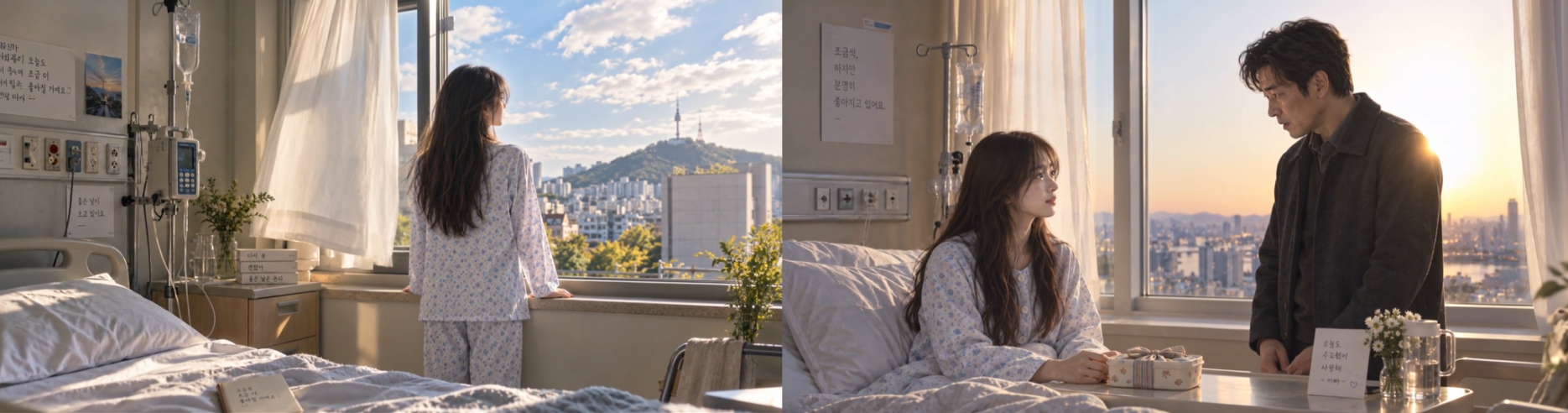
We also repeated compositions deliberately. The father sits alone at a kitchen table beside a family photo at 0:51 and again at 3:33, but the second time he cooks. The close-up of mother and daughter holding hands (0:15) is answered by Hayun's hands receiving a wrapped lunchbox (3:51). The ward is reframed in near-identical setups before and after the outings, showing that the space is the same but her feelings are not.
C. Motifs: food, notebook, window
Food structures the arc. Bland porridge on a tray defines the routine; fish-cake broth in a paper cup, tteokbokki, and a fish-shaped pastry mark each step outward; the father's home-made lunchbox closes it. The notebook first holds imagined tastes and finally real ones. The window changes most. In the routine it is a backlit boundary Hayun only looks through. In the ending a curtain lifts in the wind and she stands facing Namsan Tower under a clear sky. The last line, "Today, I ate the world," fuses all three motifs.
D. Intertitles and sound
We removed spoken lines in editing and replaced them with seven handwritten-style intertitles on black, from "Mom's last words turned Dad's love into fear" to "I didn't know protecting meant confining." Each card works as a chapter break and gives the viewer time to infer what the image withholds. A single wistful score, which we raised and lowered at key moments, binds the episodes.
V. Conclusion and Future Work
The Taste That Lingers… tells a story of release through controlled contrast: a desaturated ward, warm saturated streets, and repeated frames that change meaning. Food, notebook, and window turn an inner change into visible objects.
While AI enabled us to render a variety of spaces and scenes that would have been difficult to shoot in practice, it also introduced inconsistencies across several shots, where characters' faces, clothing, and body proportions shifted subtly. Maintaining natural motion proved especially challenging when two or more figures appeared together or when scenes involved hand movement. In addition, generating multiple variations of the same scene in pursuit of a desired atmosphere required considerable time and repeated iterations.
To compensate, we leaned on close-ups, static compositions, and slow camera movements rather than large physical action. In future work, we plan to refine character references more carefully and unify the lighting and camera framing for each scene, with the aim of improving visual consistency across the film. We also intend to add voice performance, lip-sync, and sound effects tied to each character's dialogue and actions, so that the work can develop into a piece where story and emotion come first and the fact that it was produced with AI recedes into the background.
Acknowledgments. This research was supported by the Gyeongbuk ANCHOR system through the Gyeongbuk ANCHOR CENTER, funded by the Ministry of Education (MoE) and Gyeonsangbuk-do, Republic of Korea (2026-ANCHOR-15-107).
References
[1] B. Block, The Visual Story: Creating the Visual Structure of Film, TV and Digital Media, 2nd ed. Burlington, MA, USA: Focal Press, 2008.
[2] P. Bellantoni, If It's Purple, Someone's Gonna Die: The Power of Color in Visual Storytelling. Burlington, MA, USA: Focal Press, 2005.
[3] D. Bordwell, K. Thompson, and J. Smith, Film Art: An Introduction, 12th ed. New York, NY, USA: McGraw-Hill Education, 2019.
[4] H. Choo, “Production notes for the short film The Taste That Lingers…,” unpublished, 2026.