Static Mise-en-Scène and Offscreen Sound in the Generative AI Horror Short “Let’s Play with Dolls!”
JinJu Park, Dept. of New Media and Game Design, Daegu Catholic University
Gyeongsan-si, Korea (south), iiid@cu.ac.kr
Ensil Jung, Studio Realive
Seoul, Korea (south), ensil@smtown.com
Souhwan Choe*, Dept. of New Media and Game Design, Daegu Catholic University
Gyeongsan-si, Korea (south), swann@cu.ac.kr
* Corresponding author
Abstract — This paper presents the directing strategy and production process of the short horror film "Let's Play with Dolls!" (original Korean title: "인형과 놀아요!"), made with generative AI, in which fear arises from static shots and offscreen sound rather than motion. The protagonists are ball-jointed dolls left in an abandoned mansion; their human form and inability to move on their own serve as the core source of fear. The film never shows a monster or the moment of death. Instead, it implies an unseen presence through acousmatic sound and intercuts the present-day ruin with past scenes rendered in the style of classic film. In production, the characters' appearance was fixed and motion was suppressed to address the temporal consistency problem of AI video. This case shows how the technical limits of AI video can be turned into a static horror aesthetic.
Generative AI now lets individual creators make short films, yet AI video still suffers from temporal inconsistency: characters and spaces drift between shots, and errors increase with larger motion [3]. This study treats that constraint as an aesthetic resource. Horror has long built tension by withholding what it shows [2], and dolls, human-like yet lifeless, evoke the uncanny on their own [1].
We document the concept, directing, and production of an AI short horror film starring ball-jointed dolls, showing how static, sound-centered directing produces fear and how character consistency can be maintained in AI video.
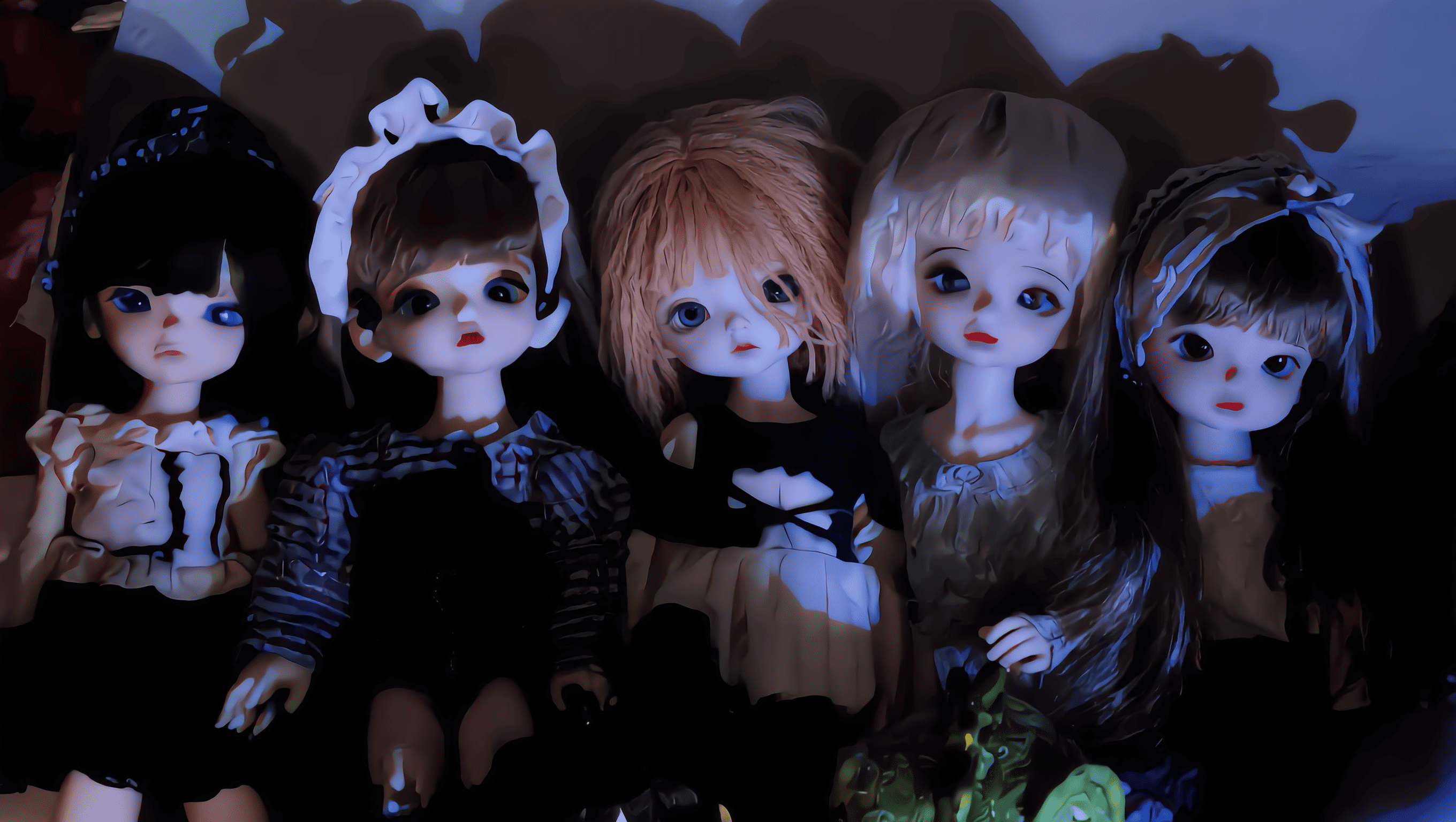
Figure 1. Ball-jointed dolls establishing the film's visual contrast.
II. Background
A. The Uncanny Valley and Dolls
Mori proposed the uncanny valley: affinity for an artificial figure rises as it grows more human-like, then drops into unease when it is almost, but not quite, human [1]. He argued that movement amplifies the effect; when something that should be still begins to move, discomfort deepens. With realistic eyes and near-human joints, ball-jointed dolls sit squarely in this valley.
B. Offscreen and Acousmatic Sound
Chion defined acousmatic sound as sound whose source is unseen, and argued that the opposition between visualized and acousmatic sound underlies the notion of offscreen space [2]. Viewers fill the gap left by an unconfirmed source with their own imagination, and horror cinema has long used this perceptual gap as a source of tension.
C. Temporal Consistency in AI Video
Video generation models predict accurately over short horizons, but when content leaves the view and returns, they tend to invent something different [3]. This directly constrains narrative filmmaking, in which the same character must reappear across many shots.
III. Concept and Synopsis
The film expresses fear through subtle movements of images and sound instead of frightening monsters or entities. The main stage of this film is a long-abandoned mansion; Juxtaposing the present ruin with the past, when children played with the dolls, reveals how an ordinary space decayed. The theme is not escape from horror but the memories and traces left in the space.
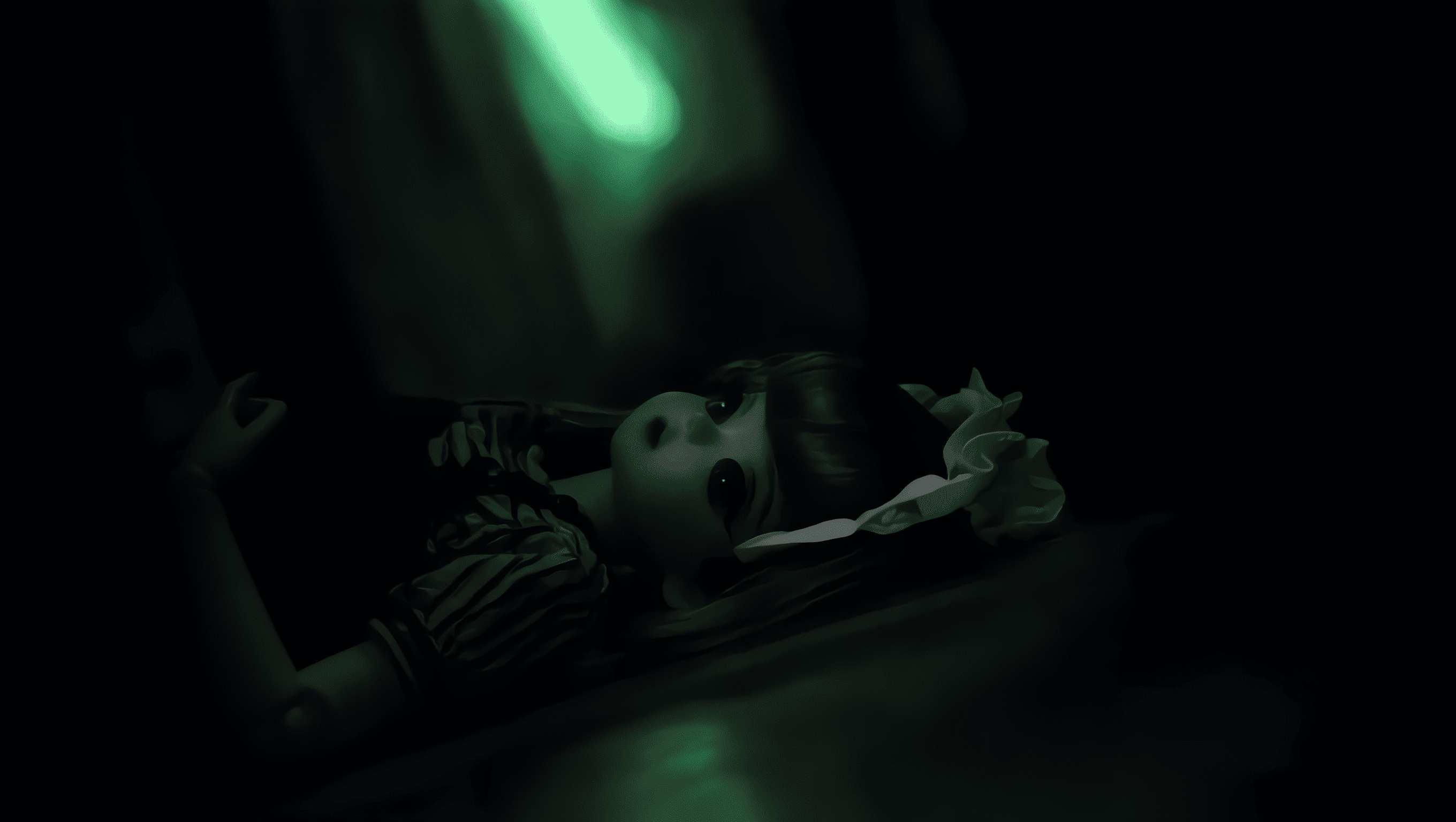
The story opens with a snapping sound over a black screen, then cuts to a doll with unnatural joints. Sensing an strange presence and sound, the other dolls decide to leave the space. As they move, glimpses of the past appear on screen where children playing with them.
Back in the present, the dolls hear an unexplained sound, freeze, and turn toward it, but nothing appears on screen. One by one, they disappear or are found grotesquely broken, until only one doll, the protagonist, remains. She finally reaches the door and meets the gaze of something before the screen goes black. The film closes with the mansion in flames, implying that the last doll burns along with it. The ending is never fully revealed and is left open to the audience's interpretation.
Figure 2. A distorted doll in a dark setting
IV. Directing Strategy
Stillness.
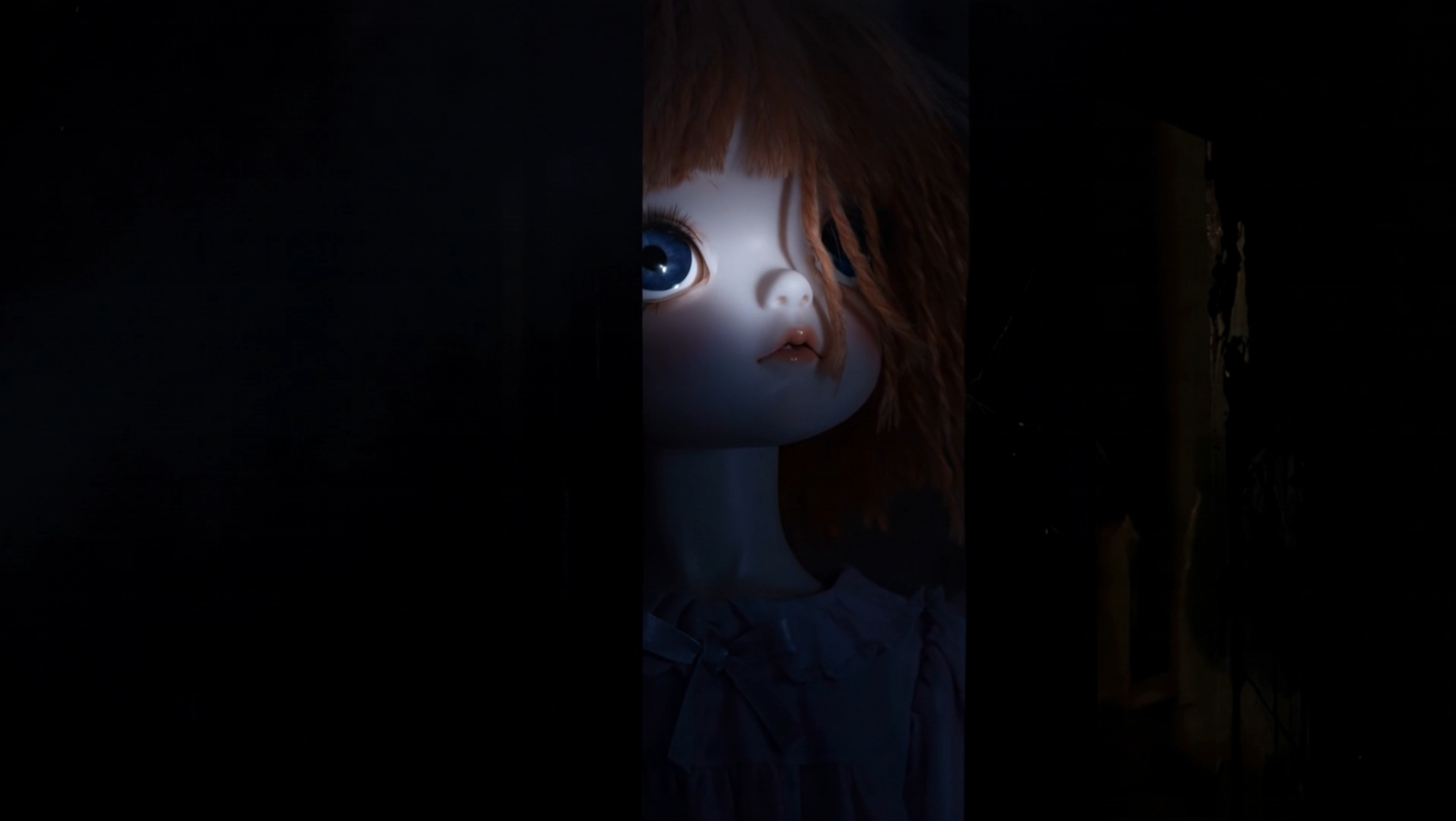
Doll and camera movement are minimized, and the dolls are shown at rest for extended durations. Close-ups of faces, hands, and joints draw attention to small changes and are linked to sounds offscreen. A frozen gaze leaves viewers wondering whether something just moved, sustaining from a still state the violation of expectations about motion [1].
Sound.
Footsteps, creaking wood, dragging, joint clicks, and moving doors imply a presence. After each sound, the static shot is held and the source is never shown, so viewers imagine the cause themselves. Because the source is never visualized, the unseen presence expands across the whole offscreen space [2].
Ellipsis of death.
A snapping sound over black precedes the image of the broken doll, so viewers see only the result and imagine the process. The ellipsis lowers explicitness while raising the intensity of fear.
Past and present.
The present uses low saturation and dark tones; the past has the faded look of classic film. The warmth of memory makes the present feel colder and stranger.
V. Production Process
Production had four stages. First, the three-minute running time was divided into cuts of five to ten seconds, each specifying camera position, doll pose, space, and sound. Second, images of the dolls, the ruin, the past mansion, and the children were generated, with the protagonist's face, hairstyle, costume, and body type fixed as a reference across all generations; film grain and scratches were added to past scenes. Third, images were animated with low motion intensity to prevent unwanted movement or expression changes, and clips with body distortion or background deformation were regenerated. Fourth, past and present were intercut in editing, and the spacing and volume of sound were tuned so that sound and silence are felt before motion.
Minimizing motion thus served as both a directing choice and a technical strategy that reduces appearance drift between frames [3].
Figure 3. Close-up framing and limited illumination implying an offscreen threat.
VI. Conclusion
This study produced a static horror film with generative AI using ball-jointed dolls and documented its process. Its core is letting viewers imagine an unseen presence through sound and the dolls' reactions, and narrating the memory of a space by intercuting past and present. Future work will define the mansion's past and why the dolls are bound to it, refine the storyboard leading to the fire, and test the directing effects with audience studies.
Acknowledgments. This research was supported by the Gyeongbuk ANCHOR system through the Gyeongbuk ANCHOR CENTER, funded by the Ministry of Education (MoE) and Gyeonsangbuk-do, Republic of Korea (2026-ANCHOR-15-107).
References
[1] M. Mori, K. F. MacDorman, and N. Kageki, "The uncanny valley [from the field]," IEEE Robot. Autom. Mag., vol. 19, no. 2, pp. 98–100, Jun. 2012.
[2] M. Chion, Audio-Vision: Sound on Screen, C. Gorbman, Ed. and Trans. New York, NY, USA: Columbia Univ. Press, 1994.
[3] W. Yan, D. Hafner, S. James, and P. Abbeel, "Temporally consistent transformers for video generation," in Proc. 40th Int. Conf. Mach. Learn. (ICML), Honolulu, HI, USA, 2023, pp. 39062–39098.
[4] J. Park, “Production description and project materials,” unpublished, 2026.