AI Hallucination: A Study on the Failure of Off-Screen Space in Image-to-Video Generation —A Case Study of Dreamina
Yichen Liu*, Department of Visual Contents, Dongseo University
Busan, Korea (south), yichen0704.nathan@gmail.com
Zhou JiaNi*, Department of Visual Contents, Dongseo University
Busan, Korea (south), moses472530@gmail.com
* Corresponding author
Abstract — This paper tests whether AI image-to-video models can maintain spatial coherence when spatial information is missing, by controlling "staircase visibility" as an independent variable. The experiment uses the Dreamina platform, model version Seedance 2.5, with three occlusion conditions (30%, 70%, and 100% occlusion), generating five videos per condition. The findings reveal a clear progressive pattern in AI spatial hallucination: when spatial information is sufficient, errors appear mainly in textual and other spatial details; when spatial information is partially missing, AI begins to fabricate architectural elements at spatial boundaries; when spatial information is completely missing, spatial structure collapses entirely, with the staircase either disappearing or being replaced. This paper argues that AI video generation does not "reconstruct" off-screen space but probabilistically completes it through the image. This finding has implications for virtual production, spatial narrative, and the indexicality of AI-generated imagery.
In recent years, image-to-video tools represented by Dreamina have made it possible to generate a "Room Tour" from as few as 8–10 still photographs. These tools offer a new form of spatial representation: viewers can move through a three-dimensional space constructed entirely by algorithm. In film theory, however, the movement of the camera through space has never been neutral—it is a form of mise-en-scène, a deliberate organization of on-screen and off-screen space (Burch, 1973; Bordwell, 1985). The Room Tour as an image form especially depends on the relationship between "showing" and "hiding": the camera continuously reveals and conceals space during movement, and viewers infer off-screen space based on visible on-screen cues.
This paper asks: when AI generates a Room Tour from a series of still photographs, what happens to off-screen space? More specifically, when a key spatial feature—the staircase—is deliberately occluded from the input photographs, how does AI's spatial reconstruction degrade? Can it maintain spatial coherence? Will it "hallucinate" a staircase where none exists? Or will spatial relations collapse?
This paper argues that AI video generation does not "reconstruct" off-screen space in the cinematic sense. It does not "imagine" a coherent off-screen space but probabilistically completes space according to statistical patterns in its training data—what might be called AI common sense. This completion degrades in a regular pattern as visual information decreases.
II. Literature Review
A. Off-Screen Space in Film Theory
Noël Burch (1973) distinguished six regions of off-screen space: the space beyond the four borders of the frame, the space behind the camera, and the space behind the set. For Burch, off-screen space is not a void but a structural absence—it is implied, suggested, and often deliberately manipulated by the director. The camera's movement into off-screen space is a fundamental tool of cinematic narrative. Meanwhile, Bordwell (1985) emphasized that spatial coherence in film depends on the viewer's cognitive construction of a coherent space from discontinuous shots. The viewer builds a "cognitive map" in the mind, and the director's task is to guide this construction through consistent camera movement, eyeline matches, and spatial anchors.
B. AI Video Generation and Spatial Coherence
Recent research on AI video generation has focused primarily on temporal coherence, visual quality, and prompt adherence (Brooks et al., 2024; Blattmann et al., 2023). However, spatial coherence—the ability to maintain a consistent three-dimensional structure during camera movement—remains a major challenge. Unlike reconstruction techniques based on explicit 3D representations such as Gaussian Splatting, current mainstream image-to-video generation models (such as Dreamina Seedance 2.5) lack explicit 3D geometric constraints and rely mainly on 2D image priors for pixel prediction. As a result, they are prone to object deformation, disappearance, and spatial relationship errors when maintaining spatial structure.
C. Indexicality and AI Imagery
Bazin (1960) and Kracauer (1960) argued that photographic images possess indexicality: the image is not an imitation of reality but a trace left by reality. In contrast, AI-generated images have no such direct connection to reality. They are not traces left by real things but results synthesized by algorithms based on training data. This paper discusses: when AI generates a Room Tour from a series of photographs, to what extent does it deviate from the real space? And is the degree of deviation controlled by the spatial details presented in the photographs?
III. Methodology
A. Experimental Design
I selected a real space: a space with a staircase, a corridor, tables and chairs, and a lounge area. This space was chosen because it contains a clear spatial feature—the staircase—that can be gradually occluded as a controlled variable.
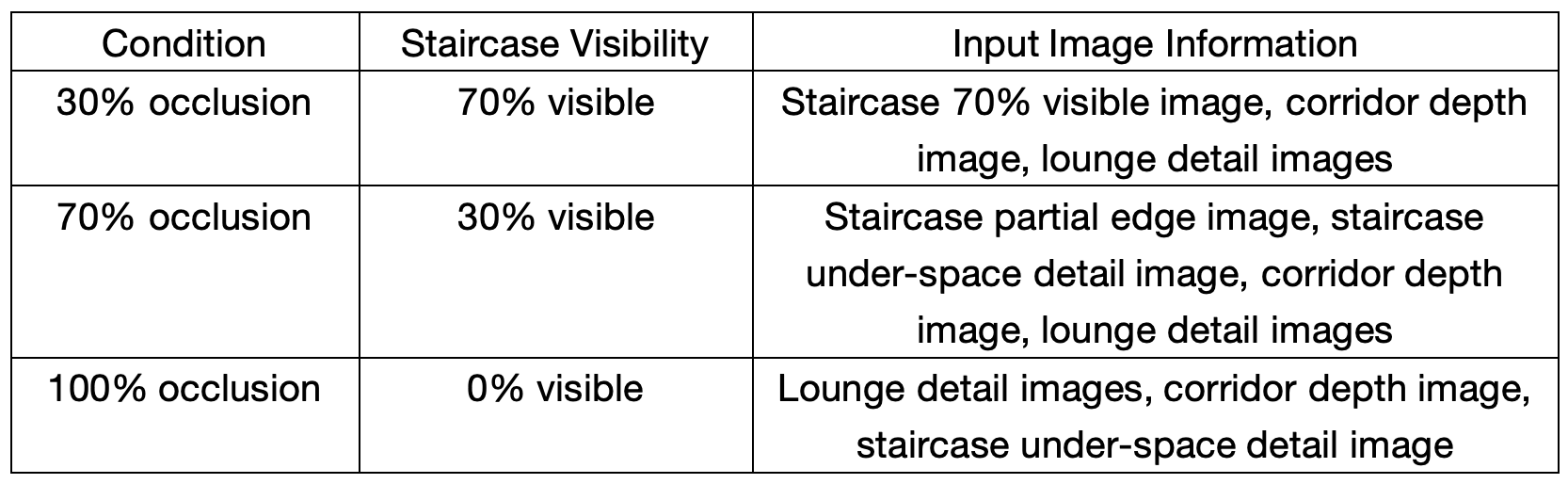
Based on field research, I set up three occlusion conditions, and each condition used the same "environmental anchor" images, including tables, chairs, partitions, and the corridor, ensuring that the only variable was the visibility of the staircase.
Figure 1. Experimental Design
B. Prompt Design
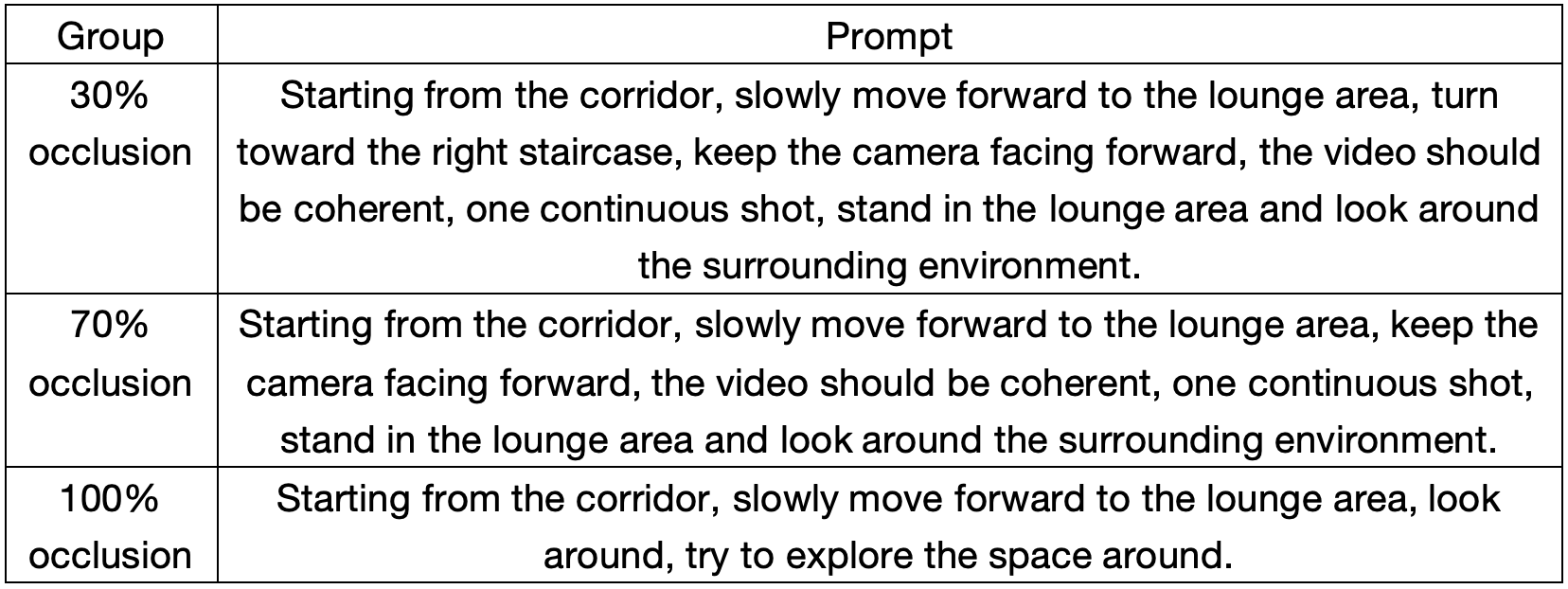
To avoid contaminating the spatial variable, the prompts describe only camera movement, not spatial content or details. The prompts are as follows:
Under the 70% and 100% conditions, the prompts gave no directional guidance, to avoid influencing the spatial hallucination produced by AI image-to-video generation.
Figure 2. Prompts for the Three Occlusion Groups
C. Generation and Data Collection
All videos were generated on the Dreamina platform using model version Seedance 2.5. Five videos were generated per group, for a total of 15 videos. Generation parameters were uniformly set to: 16:9 aspect ratio, 480P resolution, 10-second duration. All generations used the same account and did not use additional camera movement skills, to ensure the uniqueness of variables.
Videos were analyzed along four dimensions: staircase presence, staircase direction, staircase position, and spatial details.
IV. Experimental Findings
A. 30% Occlusion Group: Spatial Detail Drift
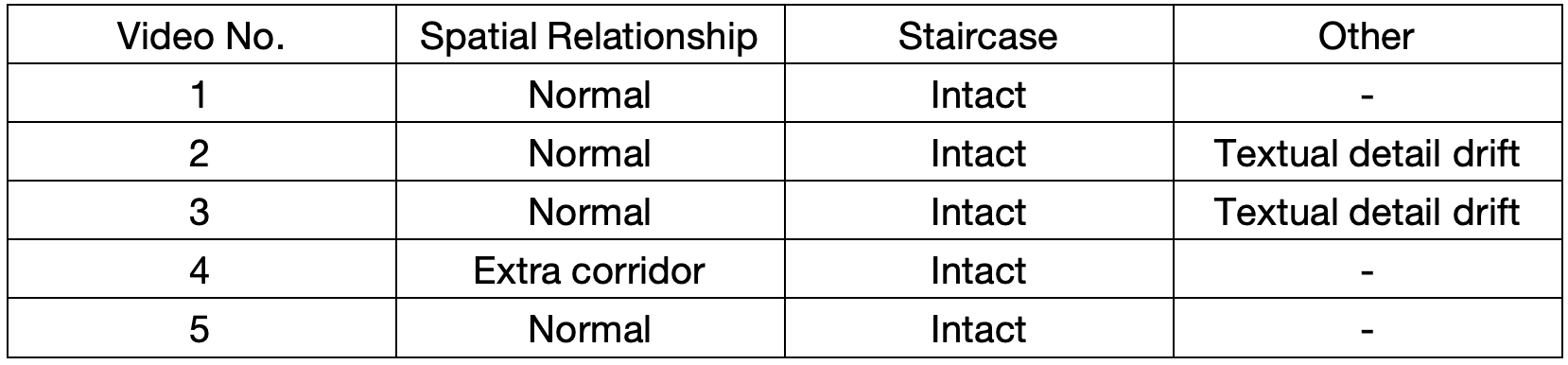
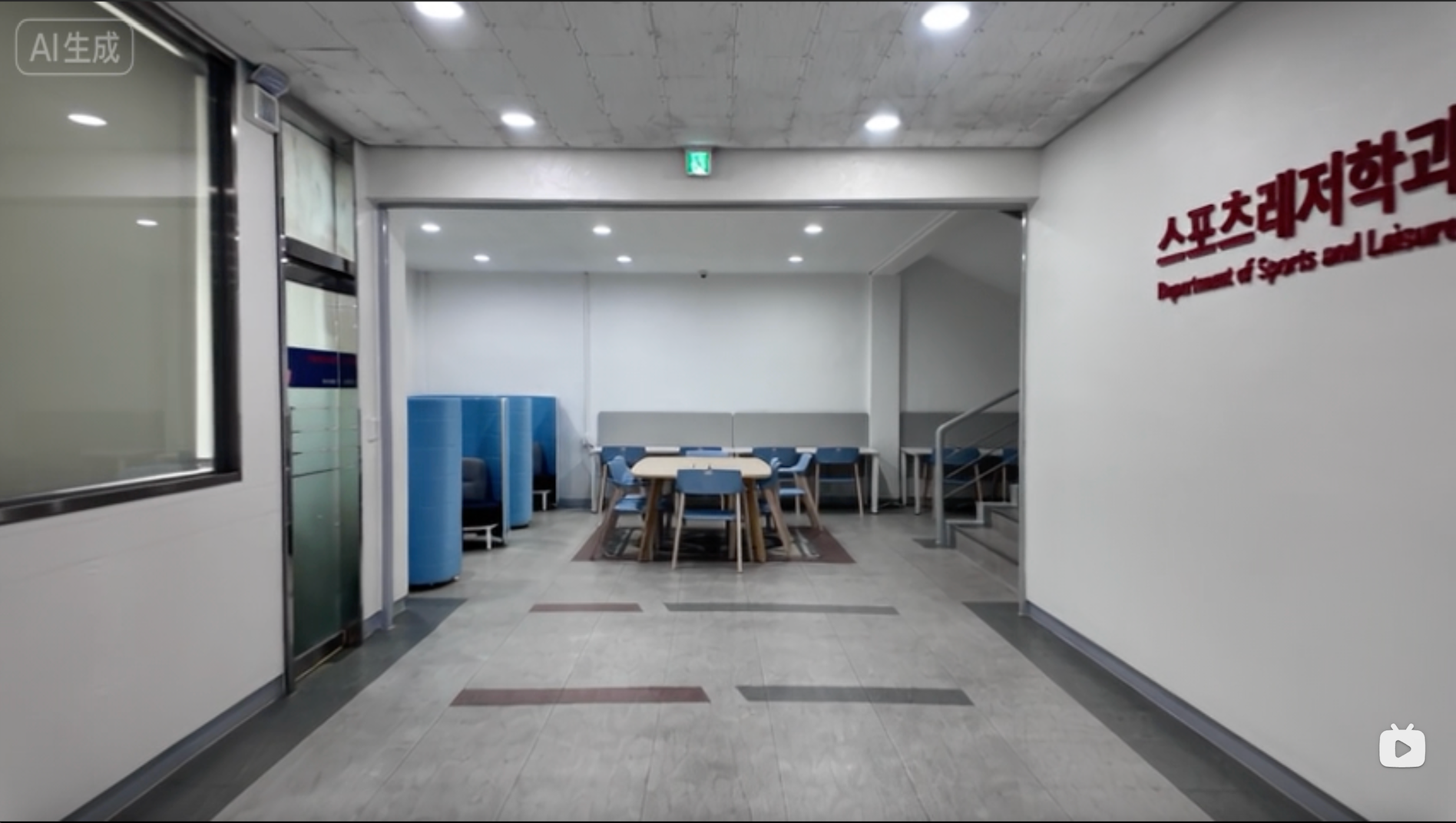
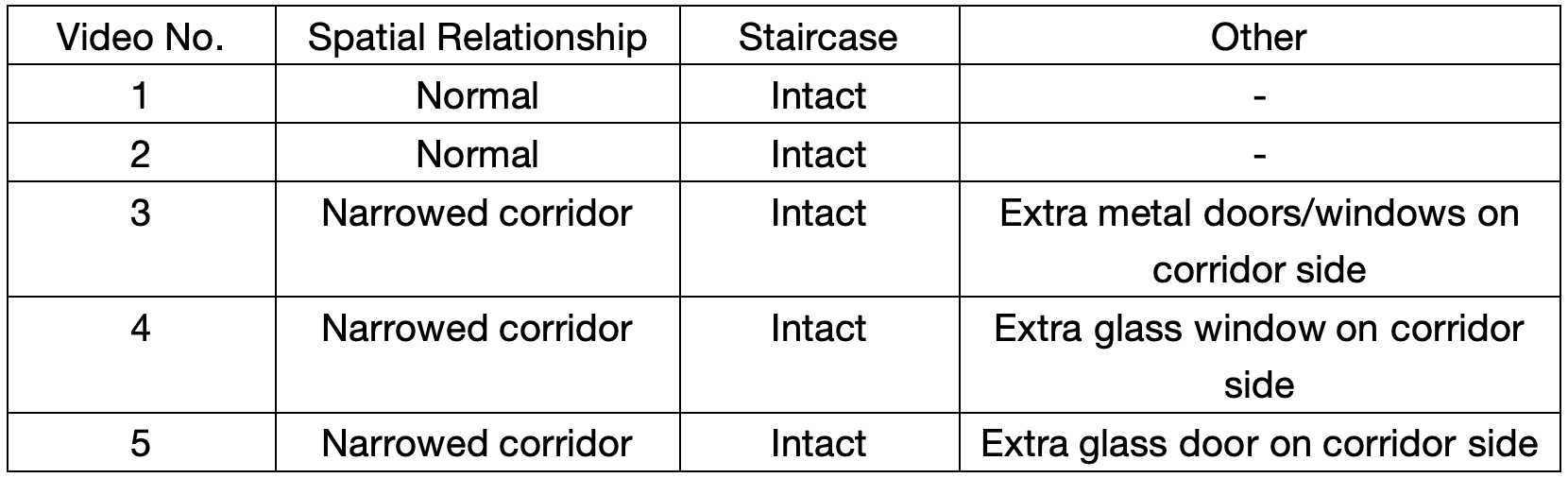
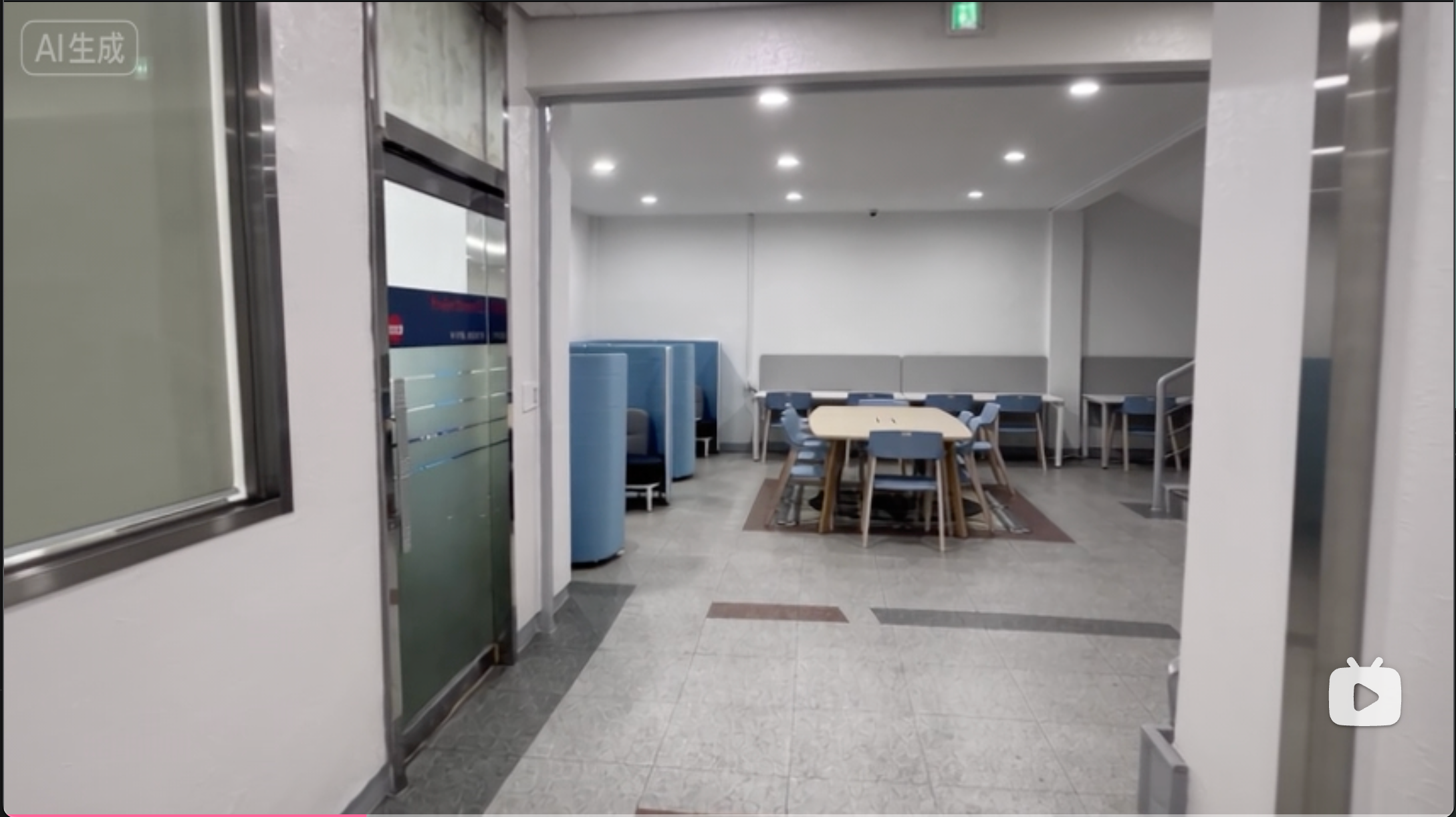
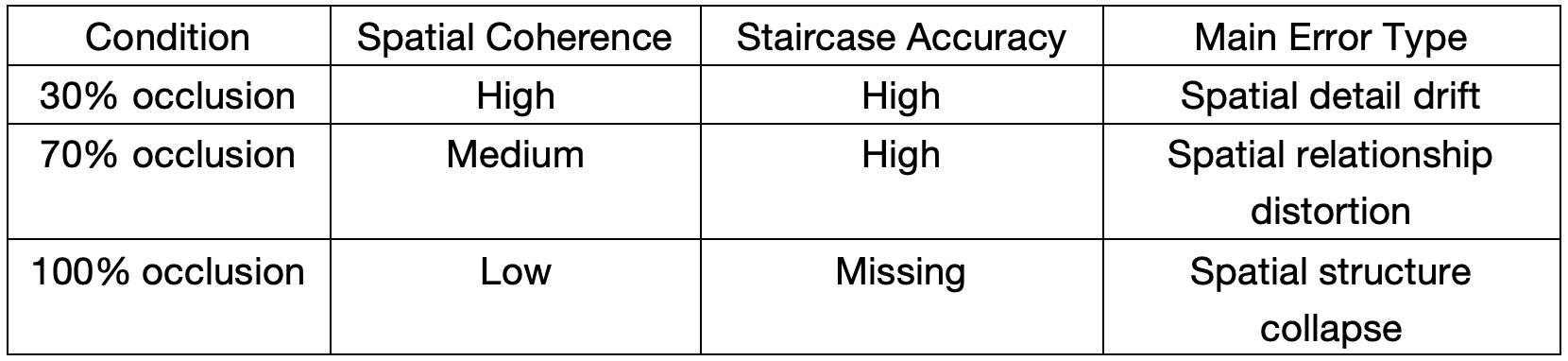
Under the 30% occlusion condition, spatial relationships were largely maintained. Four out of five generations showed correct spatial relationships. The only anomaly was an extra non-existent corridor, but the staircase itself remained intact. Notably, textual detail drift occurred twice out of five generations: text in the lounge area shifted.
This indicates that when spatial information is sufficient, AI prioritizes preserving the core spatial structure, and errors occur mainly in textual and other minute spatial details.(see Figure 1)
Figure 3. Results of the 30% Occlusion GroupFigure 4. Text drift in the 30% occlusion group.
B. 70% Occlusion Group: Spatial Relationship Distortion
Under the 70% occlusion condition, spatial relationships began to show systematic distortion. Three out of five generations showed a narrowed corridor and extra metal doors or glass windows on the right side of the corridor. However, the staircase itself showed no deformation.
This indicates that even when staircase visibility is reduced, AI can preserve the core structure of the staircase, but it compensates for missing information in the images by fabricating architectural elements, and these elements appear mainly at the boundaries of the space.(see Figure 2)
Figure 5. Results of the 70% Occlusion GroupFigure 6. Corridor distortion and extra elements in the 70% occlusion group.
C. 100% Occlusion Group: Spatial Structure Collapse
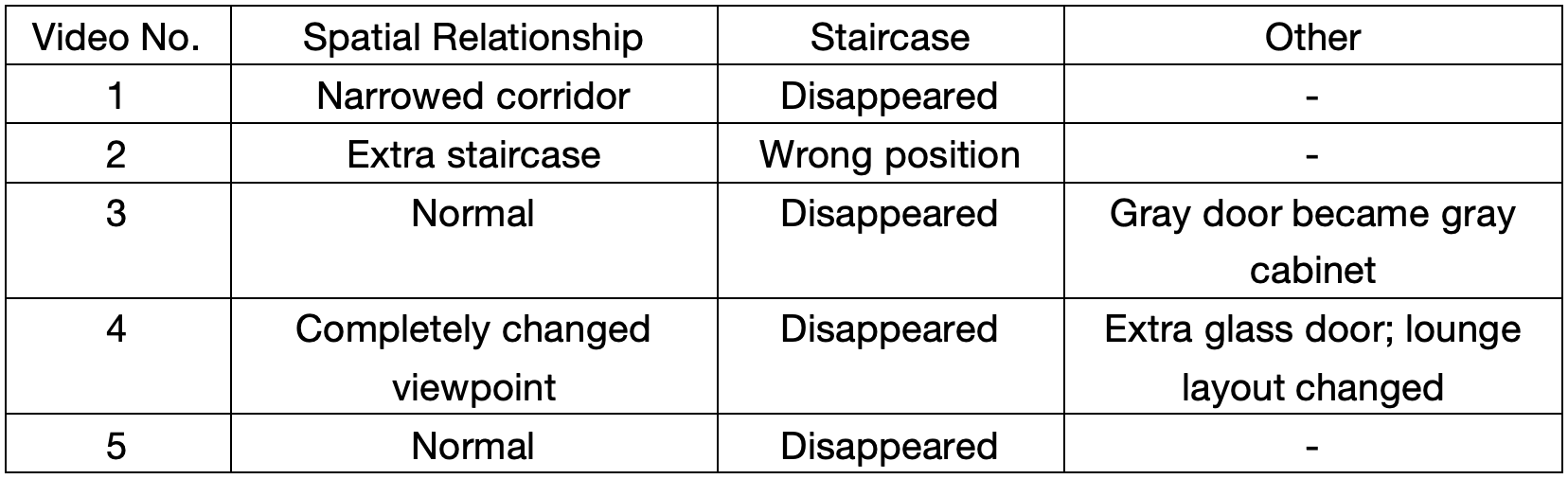
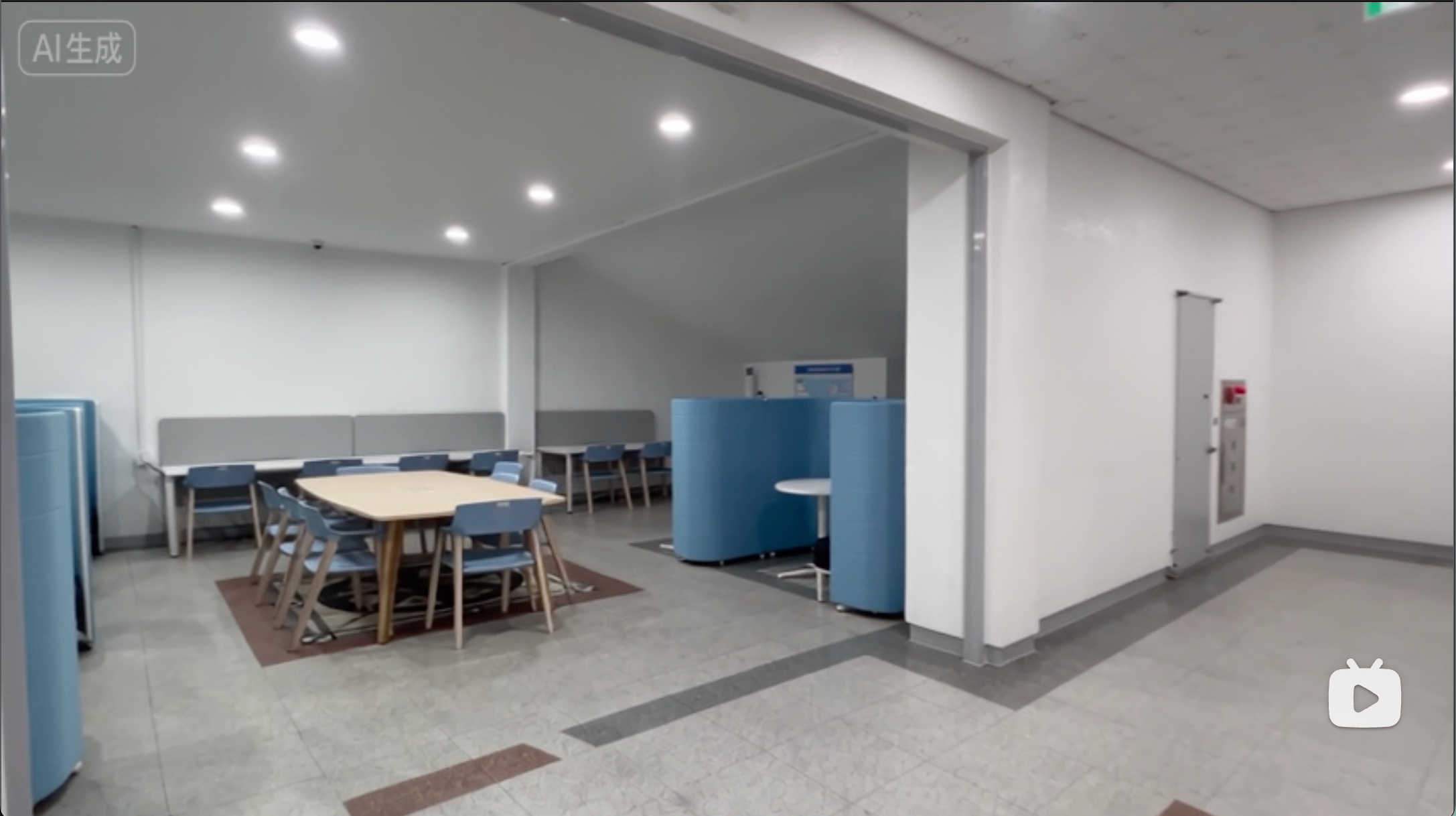
Under the 100% occlusion condition, spatial structure was observed to collapse. The staircase largely disappeared from the generated videos or appeared in completely wrong positions; the gray door under the staircase was replaced by a gray cabinet; the camera viewpoint also shifted; meanwhile, the layout of the lounge area was completely reorganized.
This indicates that when staircase information is completely missing, AI cannot generate the correct staircase structure. It either completely ignores the staircase or fabricates a spatial structure entirely unrelated to the real space.(see Figure 3)
Figure 7. Results of the 100% Occlusion GroupFigure 8. Structural collapse and missing staircase in the 100% occlusion group.
D. Summary of Findings
Figure 9. Summary of Experimental Results
V. Conclusion
A. Progressive Pattern of Spatial Hallucination
This study found a clear progressive pattern through experimentation:
First, detail drift: when spatial information is sufficient, errors first appear in textual, labeling, and other semantic details. Spatial structure remains intact.
Second, spatial boundary distortion: when spatial information is partially missing, AI fabricates architectural elements at spatial boundaries—extra doors, windows, or narrowed corridors.
Finally, spatial structure collapse: when spatial information is completely missing, AI cannot maintain a consistent structure. It either ignores the missing feature or fabricates an erroneous structure.
This pattern demonstrates that AI's spatial generation is not a uniform process. It has a priority for protecting core spatial structures but not for some boundary details, and it degrades progressively in a predictable order as information decreases.
B. Statistical Completion of Off-Screen Space and Its Evidentiary Problem
In classical film theory, off-screen space is implied, suggested, and deliberately manipulated by the director; in AI-generated Room Tours, off-screen space is not structural but statistically completed based on data accumulated during AI training. AI does not "know" there is a staircase off-screen. It cannot "imagine" a coherent space. It merely predicts pixels according to statistical patterns in training data. When visual evidence is sufficient (30% occlusion), prediction is constrained by input images; when visual evidence is insufficient (100% occlusion), prediction is unconstrained, and AI generates a space that appears plausible but is actually erroneous.
Under the limited conditions of this experiment, this raises a noteworthy question regarding the indexicality of AI-generated video. It suggests that if AI is used to complete off-screen space, the generated video may not fully serve as evidence of real space. In the observations of this study, it is not a trace of reality but a probabilistic simulation of reality based on images. Future research with larger samples and multiple models is needed to verify this inference.
C. Research Limitations and Future Outlook
This paper examined the limits of AI spatial reconstruction from two-dimensional images through an AI image-to-video experiment controlling staircase occlusion ratio. This study found that AI spatial hallucination exhibits a clear progressive pattern: spatial detail drift, spatial boundary distortion, and spatial structure collapse. AI video generation does not reconstruct off-screen space but probabilistically completes it. Under the limited conditions of this study, this may pose a potential challenge to the indexicality of the moving image, and may present challenges for applications requiring spatial precision. But it also opens new possibilities for spatial expression and creative practice.
For filmmakers, this study shows that AI-generated video from images is not yet reliable for applications requiring spatial precision. They can generate visually plausible spaces but cannot guarantee complete correctness of spatial structure; in virtual production, where spatial coherence is crucial, AI-generated space must be constrained by 3D data or spatial anchors. Future research should extend this experiment to other spatial features and other AI models to test whether this progressive pattern is universal.
References
[1] N. Burch, Theory of Film Practice, New York, NY, USA: Praeger, 1973.
[2] D. Bordwell, Narration in the Fiction Film, Madison, WI, USA: University of Wisconsin Press, 1985.
[3] T. Brooks et al., "Video generation models as world simulators," OpenAI, San Francisco, CA, USA, Tech. Rep., 2024.
[4] A. Blattmann et al., "Stable video diffusion: Scaling latent video diffusion models to large datasets," arXiv:2311.15127, 2023.
[5] A. Bazin, What Is Cinema?, vol. 1, Berkeley, CA, USA: University of California Press, 1960.
[6] S. Kracauer, Theory of Film: The Redemption of Physical Reality, New York, NY, USA: Oxford University Press, 1960.